
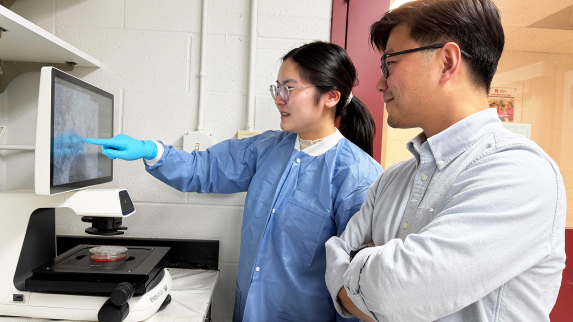
Rutgers neuroscientist Peng Jiang was visiting his hometown of Qianshan, a city in China’s Anhui province, when a neighbor came to his parents’ house with a story that would stay with him. The man’s mother had been diagnosed with Alzheimer’s disease in her early 60s. After nearly a decade of decline, she no longer recognized her own son. One morning, she looked at him and asked gently, “How is your mother doing? Is she well?”
As the neighbor recounted the moment, he broke into tears. He told Jiang that Alzheimer’s runs in his family and that he fears his own children may one day watch him fade the way he watched his mother’s memory vanish. That conversation, which took place several years ago, became a turning point for Jiang, an associate professor in the Department of Cell Biology and Neuroscience at the School of Arts and Sciences. Already deep into Alzheimer’s research, Jiang returned to his lab with renewed urgency.
“The fact that there is still no effective treatment fuels my determination to pursue new therapeutic ideas,” said Jiang, also a faculty member of the Rutgers Brain Health Institute. To read the full story.