180+ networks across 21 NJ counties
COMMUNITY ENGAGEMENT CORE OVERVIEW
NJACTS draws leading academic, industry and community groups together to understand and address the health needs of New Jersey. Central to this is engagement with our community to ensure that our efforts respond to their priorities. Our goal is to conduct research with the New Jersey community, in the community and for the community, and yet, have impact beyond our state’s boundaries.
Stay in Touch!
Join RCommunity!
Join Rutgers Health Service Corps!
Empowering Community-Based Research
Through Cultural and Linguistic Collaboration
- Navigating interpreter-mediated encounters
- Effective translation for research
- Understanding cultural nuances in literacy, trust, and belonging
Through collaboration across disciplines and leveraging expertise within and beyond Rutgers, CrEER ensures that research is culturally relevant and impactful both locally and globally.
👉 Discover how CrEER is shaping the future of community-based research here.
Association for Clinical and Translational Science (ATCS) Membership for Community Members

Did you know that community members are eligible to become members of ACTS through their affiliation with NJ ACTS?
Community members are able to access ACTS’ member benefits, including:
- Discounted registration to the annual Translational Science meeting
- Opportunities to participate in Special Interest Groups and Committees
- Access to the community platform website and more!
Resource for Investigators – CTSA Compendium of D&I Catalogs
Dissemination and implementation (D&I) research focuses on translating evidence-based interventions into real-world settings to improve health outcomes in the broader community.
An open-source CTSA Compendium of D&I Catalogs has been developed by the Clinical & Translational Science Awards (CTSA) Program’s “Advancing Dissemination and Implementation Sciences in CTSAs” working group to support investigators at any stage of their D&I skill-building journey. It provides a curated list of resource catalogs relevant to the conduct of D&I science. The materials include frameworks/theories/models, methods/measures, funding resources, and practice and training resources.
Click here to learn more.
CIRTification – A New Alternative to CITI for Community Partners
The rollout of CIRTification at Rutgers has begun. The CIRTification program provides research ethics training alternatives for individuals in community organizations, with limited understanding of conducting human research and protecting potential research participants. This option provides training focused on equipping community partners to conduct human subject research effectively and safely in their communities.
To learn more about the program at Rutgers, please visit this link CIRTification.
NJ ACTS COMMUNITY SCIENTIST PROGRAM
This program is designed to provide researchers with rapid feedback from expert community members to ensure their research projects are culturally appropriate and relevant to the community.
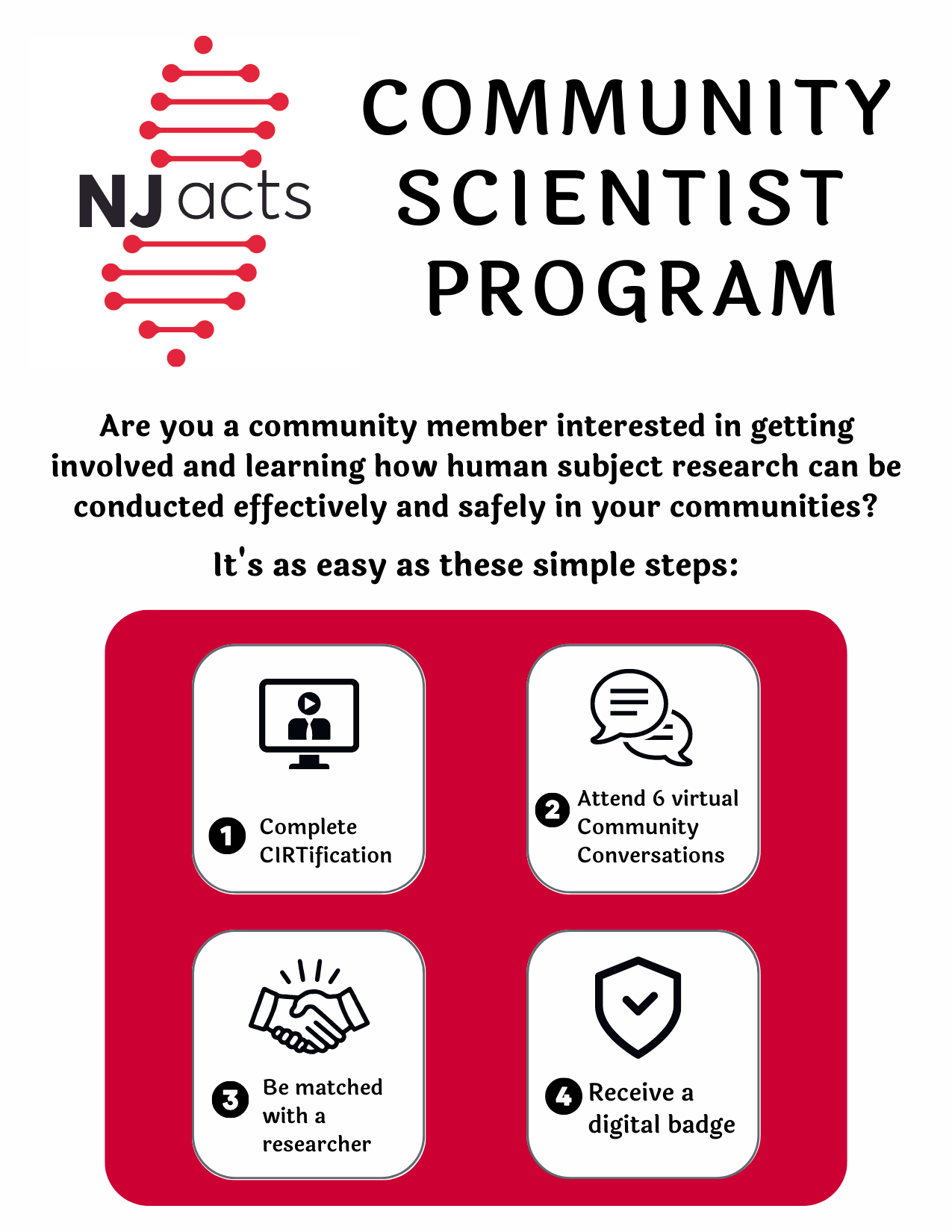
PARTICIPATE IN OUR NEXT COHORT!
For more information, please contact njactscommunity@rwjms.rutgers.edu
NJ HEROES TOO
Through the ongoing New Jersey Healthcare Essential Worker Outreach and Education Study – Testing Overlooked Occupations (NJ HEROES TOO), we have gained a wealth of data on COVID-19’s effects, gleaned valuable learnings on attitudes toward testing and vaccines, and improved COVID-19 awareness in underserved communities.

Community Blog
Children Left Behind: Rutgers–Camden researcher explains how pandemic worsened racial achievement gap.
When it comes to the pandemic’s impact on academic achievement, no children are immune. But just as COVID-19 itself has hit underserved demographics the hardest, minority students in poorly equipped schools experienced the steepest slides in the national test-score...
What an Ideal Health Care System Might Look Like: Perspectives from Older Black and Latinx Adults
While nearly all Americans age 65 and older are covered by Medicare, their experiences seeking and receiving health care can vary significantly. Research shows that older Black and Latinx Medicare enrollees commonly experience racism when seeking care, report...
CBD Shows Health Benefits in Estrogen-Deficient Mice That Model Postmenopause.
A Rutgers study points to cannabidiol (CBD), a major component of hemp and medical marijuana used to treat conditions such as chronic pain, inflammation, migraines, epilepsy, autoimmune diseases, depression, and anxiety, as a possible treatment for postmenopausal...
A ‘staggering’ number of people couldn’t get care during the pandemic, poll finds.
When the pandemic started, Tomeka Kimbrough-Hilson knew she had a small growth inside her uterus. She was first diagnosed with uterine fibroids back in 2006 and had been able to have the non-cancerous mass removed through outpatient laser surgery. Over the years,...
How to Stop the Next Pandemic Before It Starts.
The National Institute of Allergy and Infectious Diseases (NIAID) has earmarked $600 million to stop future pandemics before they start – and up to $3.8 million of that will go to a team led by Rutgers researcher Eddy Arnold. The plan is simple: Identify viruses with...
Babies born just before full term have a higher risk of ADHD, Rutgers study finds.
Babies born prematurely are known to have a higher risk of various complications and long-term health conditions, including attention-deficit/hyperactivity disorder. But babies born just a bit early – at 37 or 38 weeks – also have a high risk of developing ADHD, a...