180+ networks across 21 NJ counties
COMMUNITY ENGAGEMENT CORE OVERVIEW
NJACTS draws leading academic, industry and community groups together to understand and address the health needs of New Jersey. Central to this is engagement with our community to ensure that our efforts respond to their priorities. Our goal is to conduct research with the New Jersey community, in the community and for the community, and yet, have impact beyond our state’s boundaries.
Stay in Touch!
Join RCommunity!
Join Rutgers Health Service Corps!
Empowering Community-Based Research
Through Cultural and Linguistic Collaboration
- Navigating interpreter-mediated encounters
- Effective translation for research
- Understanding cultural nuances in literacy, trust, and belonging
Through collaboration across disciplines and leveraging expertise within and beyond Rutgers, CrEER ensures that research is culturally relevant and impactful both locally and globally.
👉 Discover how CrEER is shaping the future of community-based research here.
Association for Clinical and Translational Science (ATCS) Membership for Community Members

Did you know that community members are eligible to become members of ACTS through their affiliation with NJ ACTS?
Community members are able to access ACTS’ member benefits, including:
- Discounted registration to the annual Translational Science meeting
- Opportunities to participate in Special Interest Groups and Committees
- Access to the community platform website and more!
Resource for Investigators – CTSA Compendium of D&I Catalogs
Dissemination and implementation (D&I) research focuses on translating evidence-based interventions into real-world settings to improve health outcomes in the broader community.
An open-source CTSA Compendium of D&I Catalogs has been developed by the Clinical & Translational Science Awards (CTSA) Program’s “Advancing Dissemination and Implementation Sciences in CTSAs” working group to support investigators at any stage of their D&I skill-building journey. It provides a curated list of resource catalogs relevant to the conduct of D&I science. The materials include frameworks/theories/models, methods/measures, funding resources, and practice and training resources.
Click here to learn more.
CIRTification – A New Alternative to CITI for Community Partners
The rollout of CIRTification at Rutgers has begun. The CIRTification program provides research ethics training alternatives for individuals in community organizations, with limited understanding of conducting human research and protecting potential research participants. This option provides training focused on equipping community partners to conduct human subject research effectively and safely in their communities.
To learn more about the program at Rutgers, please visit this link CIRTification.
NJ ACTS COMMUNITY SCIENTIST PROGRAM
This program is designed to provide researchers with rapid feedback from expert community members to ensure their research projects are culturally appropriate and relevant to the community.
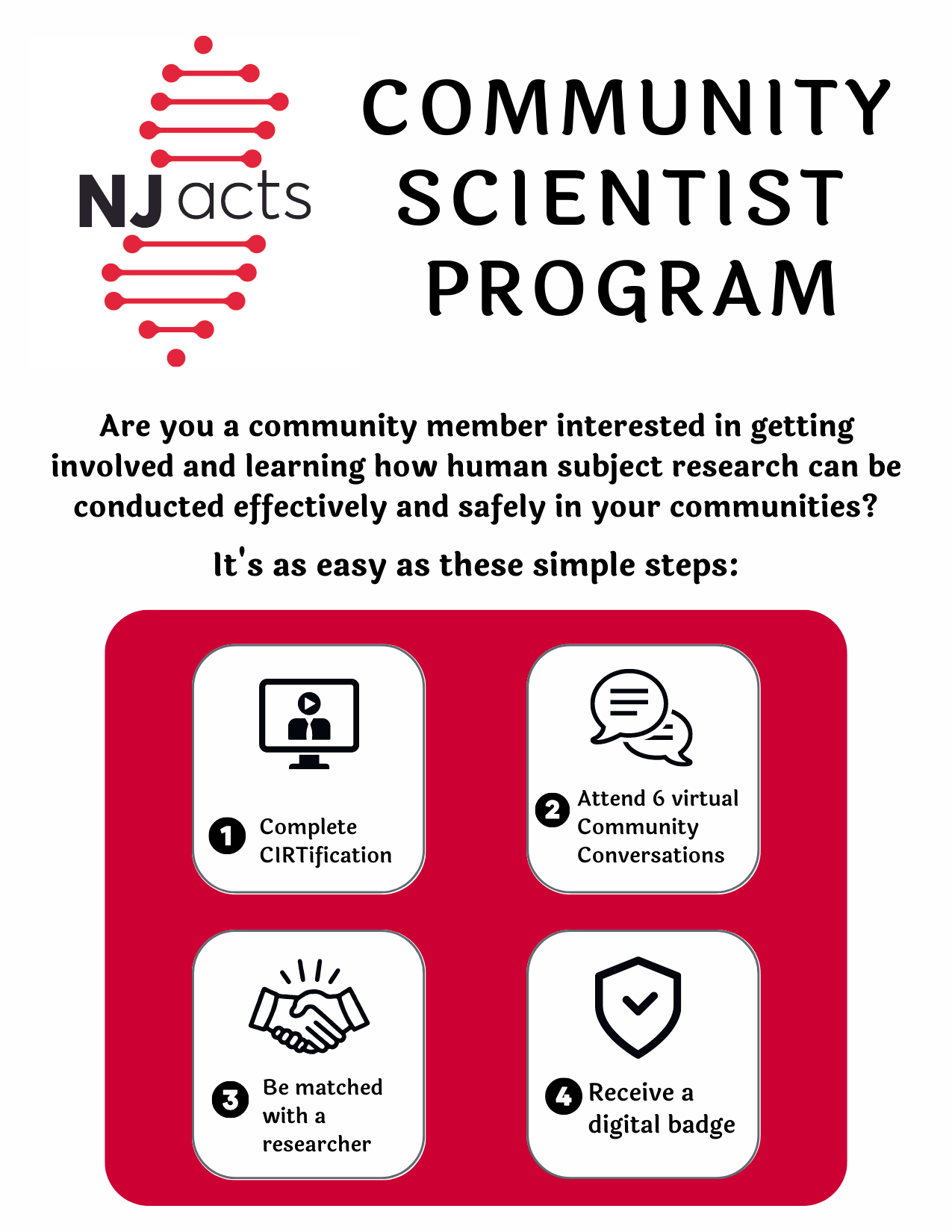
PARTICIPATE IN OUR NEXT COHORT!
For more information, please contact njactscommunity@rwjms.rutgers.edu
NJ HEROES TOO
Through the ongoing New Jersey Healthcare Essential Worker Outreach and Education Study – Testing Overlooked Occupations (NJ HEROES TOO), we have gained a wealth of data on COVID-19’s effects, gleaned valuable learnings on attitudes toward testing and vaccines, and improved COVID-19 awareness in underserved communities.

Community Blog
OPINION: There’s a social isolation epidemic. But it can be fixed.
The author of this opinion column wants policymakers across the board to think and act broadly to reverse the tide of social isolation and build social connected communities. Read the Full Article.
Is It Time to Ditch Those Cloth Masks for Something Better?
The CDC upgraded its guidance acknowledging that cloth masks are not as effective as surgical and N95 masks to protect against COVID-19 as the highly contagious Omicron variant continues to drive a record-breaking number of cases across the country. Rutgers...
OPINION: Public health is missing crucial data on LGBTQIA+ people. It’s not hard to collect
Little is known about how LGBTQIA+ people are being affected by the pandemic because few public health departments are collecting and reporting this information. The author provides information on why sexual orientation and gender identity data be collected. Read the...
Why don’t we treat omicron like a bad cold? Well, it’s more complicated than that.
The COVID-19 patients continue to stream into Holy Name, just as they have for the past month. They’re not as sick on average as they were in earlier waves of the pandemic. But they keep coming, some struggling to breathe and further straining an already exhausted...
Health care support workers have been essential yet unappreciated in pandemic, study says.
An unusual study of the COVID pandemic’s impact on the work and personal lives of an often-overlooked group of health care workers has yielded lessons about the stresses that drive them out of the workforce, their attitudes toward vaccination and testing, and the...
As COVID-19 persists, change in thinking might be near
Medical community weighs what ‘living with’ COVID-19 would mean Unlike the flu, COVID-19 is not currently considered endemic in the U.S., meaning a manageable disease that always causes a certain amount of sickness, perhaps spiking at times, and is confined to one or...