180+ networks across 21 NJ counties
COMMUNITY ENGAGEMENT CORE OVERVIEW
NJACTS draws leading academic, industry and community groups together to understand and address the health needs of New Jersey. Central to this is engagement with our community to ensure that our efforts respond to their priorities. Our goal is to conduct research with the New Jersey community, in the community and for the community, and yet, have impact beyond our state’s boundaries.
Stay in Touch!
Join RCommunity!
Join Rutgers Health Service Corps!
Empowering Community-Based Research
Through Cultural and Linguistic Collaboration
- Navigating interpreter-mediated encounters
- Effective translation for research
- Understanding cultural nuances in literacy, trust, and belonging
Through collaboration across disciplines and leveraging expertise within and beyond Rutgers, CrEER ensures that research is culturally relevant and impactful both locally and globally.
👉 Discover how CrEER is shaping the future of community-based research here.
Association for Clinical and Translational Science (ATCS) Membership for Community Members

Did you know that community members are eligible to become members of ACTS through their affiliation with NJ ACTS?
Community members are able to access ACTS’ member benefits, including:
- Discounted registration to the annual Translational Science meeting
- Opportunities to participate in Special Interest Groups and Committees
- Access to the community platform website and more!
Resource for Investigators – CTSA Compendium of D&I Catalogs
Dissemination and implementation (D&I) research focuses on translating evidence-based interventions into real-world settings to improve health outcomes in the broader community.
An open-source CTSA Compendium of D&I Catalogs has been developed by the Clinical & Translational Science Awards (CTSA) Program’s “Advancing Dissemination and Implementation Sciences in CTSAs” working group to support investigators at any stage of their D&I skill-building journey. It provides a curated list of resource catalogs relevant to the conduct of D&I science. The materials include frameworks/theories/models, methods/measures, funding resources, and practice and training resources.
Click here to learn more.
CIRTification – A New Alternative to CITI for Community Partners
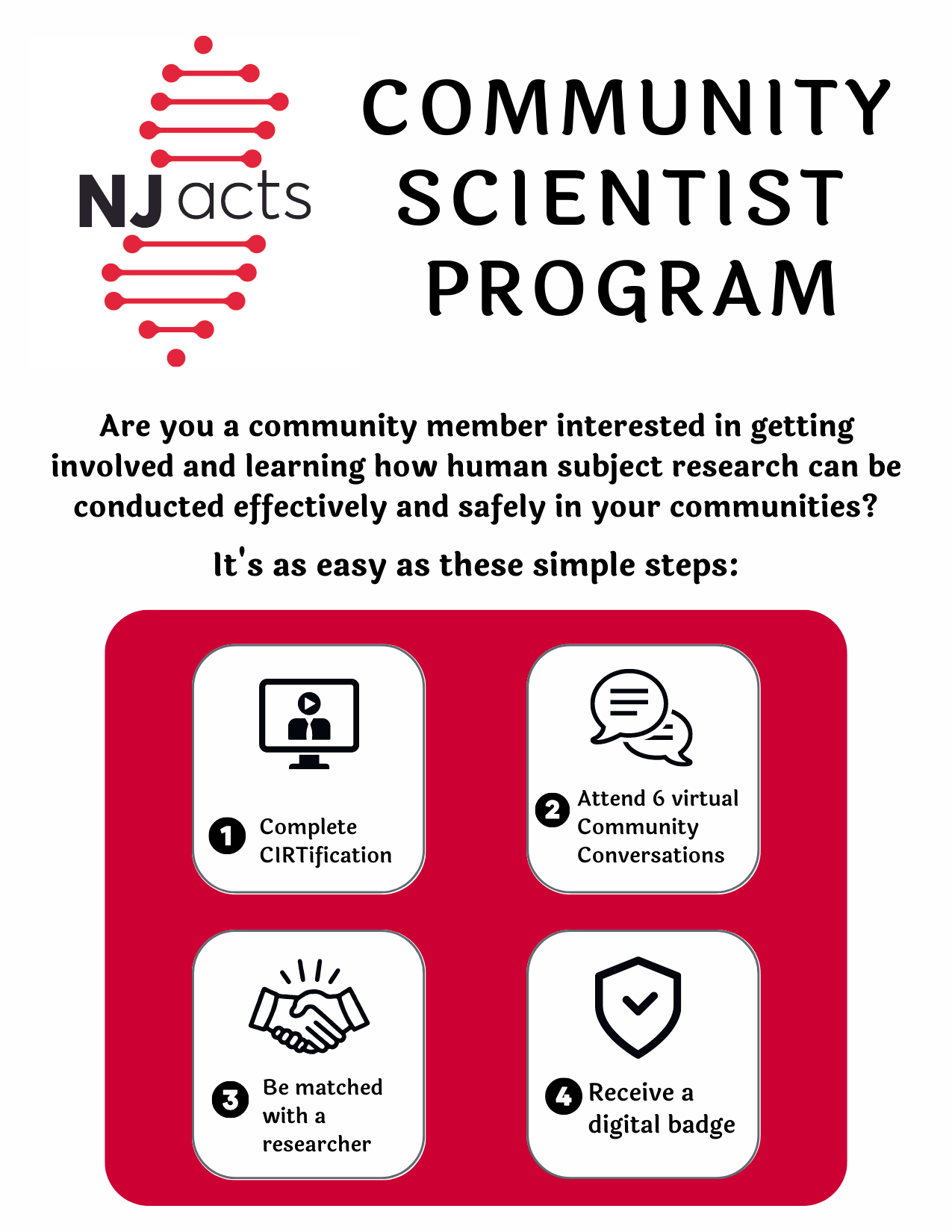
The rollout of CIRTification at Rutgers has begun. The CIRTification program provides research ethics training alternatives for individuals in community organizations, with limited understanding of conducting human research and protecting potential research participants. This option provides training focused on equipping community partners to conduct human subject research effectively and safely in their communities.
To learn more about the program at Rutgers, please visit this link CIRTification.
NJ ACTS COMMUNITY SCIENTIST PROGRAM
This program is designed to provide researchers with rapid feedback from expert community members to ensure their research projects are culturally appropriate and relevant to the community.
PARTICIPATE IN OUR NEXT COHORT!
For more information, please contact njactscommunity@rwjms.rutgers.edu
NJ HEROES TOO
Through the ongoing New Jersey Healthcare Essential Worker Outreach and Education Study – Testing Overlooked Occupations (NJ HEROES TOO), we have gained a wealth of data on COVID-19’s effects, gleaned valuable learnings on attitudes toward testing and vaccines, and improved COVID-19 awareness in underserved communities.

Community Blog
Study Offers Guidance for Improving Access to Oncology Drug Treatments in Sub-Saharan Africa.
With cancer rates rising throughout sub-Saharan Africa – home to 1.1 billion people, or about 14 percent of the world’s population – researchers with the Botswana-Rutgers Partnership for Health are seeking solutions. Cancer is among the top three causes of premature...
NJACTS Community Engagement Core COVID-19 Resources
The situation around the current spread of COVID-19 is changing rapidly. We have compiled resource links for the general community highlighting local resources across New Jersey, ways to get involved, and mental and physical wellness. Visit our COVID-19 page for...
Antipsychotic Medication Prescriptions for Children Sharply Decline.
Antipsychotic prescription medication for children has declined significantly, according to a Rutgers study that found a 43 percent drop for Medicaid-enrolled children from 45 states. Published in the July issue of Health Affairs, the study examined Medicaid claims...
Rutgers Leads Study of Wildfire Air Pollution in New Jersey.
Rutgers scientists have examined the physical and chemical attributes as well as the possible toxicological health effects of the Canadian wildfires that sharply impacted air quality in New Jersey and the New York metropolitan area. Using state-of-the-art...
Faculty Workshop in Mentoring Biomedical PhD Students on 9/13 – Register Now!
The NIH is requiring faculty to be trained in how to mentor PhD students. We are therefore offering these workshops for faculty in the biological sciences with new case studies each time. This will make our programs more competitive for training grants and...
How eavesdropping viruses battle it out to infect us.
They can lie low, quietly infiltrating the body’s defenses, or go on the attack, making many copies of themselves that explode out of hiding and fire in all directions. Viral attacks are almost always suicide missions, ripping apart the cell that the virus has been...