180+ networks across 21 NJ counties
COMMUNITY ENGAGEMENT CORE OVERVIEW
NJACTS draws leading academic, industry and community groups together to understand and address the health needs of New Jersey. Central to this is engagement with our community to ensure that our efforts respond to their priorities. Our goal is to conduct research with the New Jersey community, in the community and for the community, and yet, have impact beyond our state’s boundaries.
Stay in Touch!
Join RCommunity!
Join Rutgers Health Service Corps!
Empowering Community-Based Research
Through Cultural and Linguistic Collaboration
- Navigating interpreter-mediated encounters
- Effective translation for research
- Understanding cultural nuances in literacy, trust, and belonging
Through collaboration across disciplines and leveraging expertise within and beyond Rutgers, CrEER ensures that research is culturally relevant and impactful both locally and globally.
👉 Discover how CrEER is shaping the future of community-based research here.
Association for Clinical and Translational Science (ATCS) Membership for Community Members

Did you know that community members are eligible to become members of ACTS through their affiliation with NJ ACTS?
Community members are able to access ACTS’ member benefits, including:
- Discounted registration to the annual Translational Science meeting
- Opportunities to participate in Special Interest Groups and Committees
- Access to the community platform website and more!
Resource for Investigators – CTSA Compendium of D&I Catalogs
Dissemination and implementation (D&I) research focuses on translating evidence-based interventions into real-world settings to improve health outcomes in the broader community.
An open-source CTSA Compendium of D&I Catalogs has been developed by the Clinical & Translational Science Awards (CTSA) Program’s “Advancing Dissemination and Implementation Sciences in CTSAs” working group to support investigators at any stage of their D&I skill-building journey. It provides a curated list of resource catalogs relevant to the conduct of D&I science. The materials include frameworks/theories/models, methods/measures, funding resources, and practice and training resources.
Click here to learn more.
CIRTification – A New Alternative to CITI for Community Partners
The rollout of CIRTification at Rutgers has begun. The CIRTification program provides research ethics training alternatives for individuals in community organizations, with limited understanding of conducting human research and protecting potential research participants. This option provides training focused on equipping community partners to conduct human subject research effectively and safely in their communities.
To learn more about the program at Rutgers, please visit this link CIRTification.
NJ ACTS COMMUNITY SCIENTIST PROGRAM
This program is designed to provide researchers with rapid feedback from expert community members to ensure their research projects are culturally appropriate and relevant to the community.
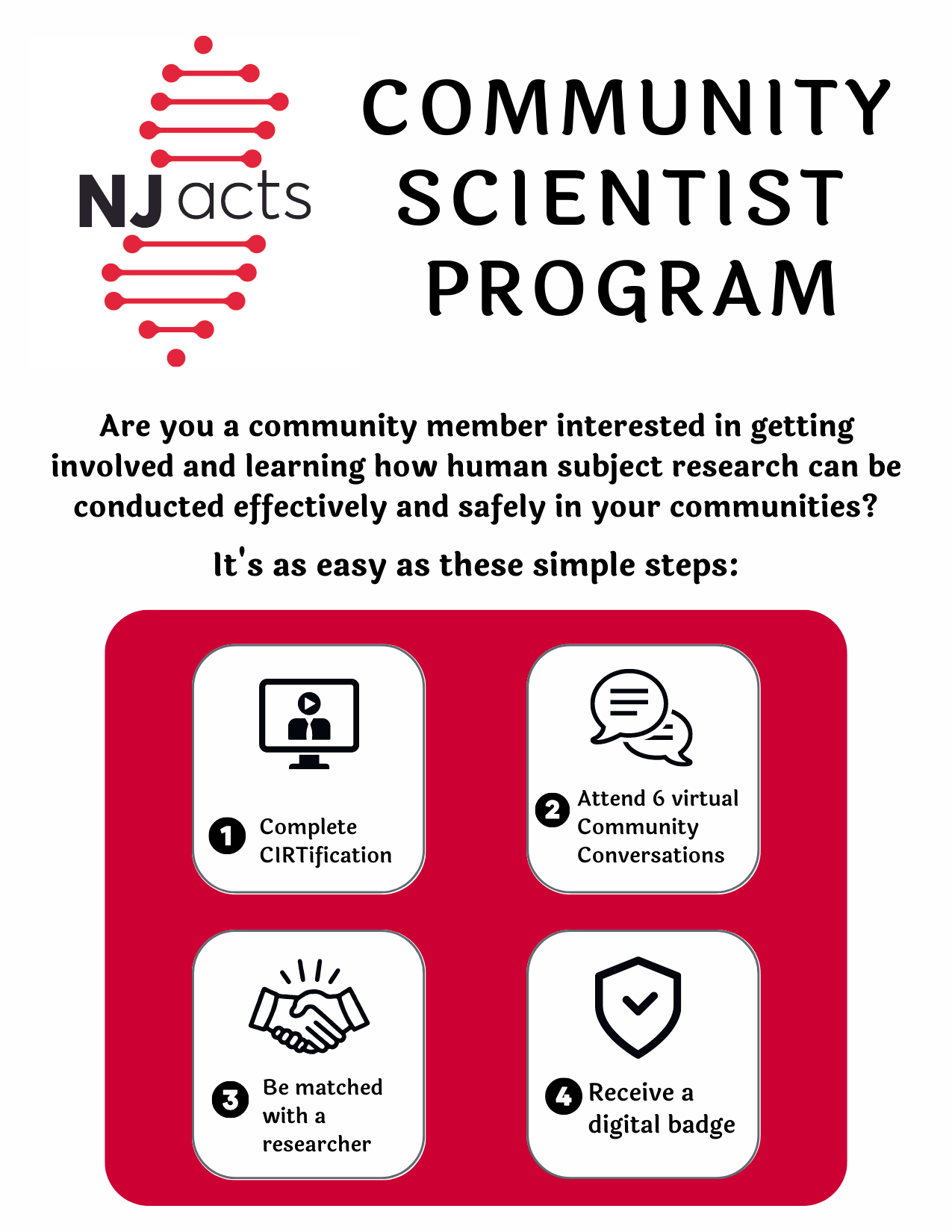
PARTICIPATE IN OUR NEXT COHORT!
For more information, please contact njactscommunity@rwjms.rutgers.edu
NJ HEROES TOO
Through the ongoing New Jersey Healthcare Essential Worker Outreach and Education Study – Testing Overlooked Occupations (NJ HEROES TOO), we have gained a wealth of data on COVID-19’s effects, gleaned valuable learnings on attitudes toward testing and vaccines, and improved COVID-19 awareness in underserved communities.

Community Blog

NJIT AI Researcher Makes Small Language Models Accessible.
While ordinary people around the world are waking up to large language models on the cloud, researchers at New Jersey Institute of Technology want you to know about the power of small models on your own hardware. It’s not unlike fifty years ago, when people were...

Tackling the Silent Threat of Inherited Heart Disease.
James Mills, a cardiologist for 35 years, knew he wanted to be a doctor when he was in first grade. “I was always fascinated by medicine,” said Mills, an associate professor of medicine at Robert Wood Johnson Medical School and a cardiologist at Robert Wood Johnson...

Researchers Develop Cognitive Tool Kit Enabling Early Alzheimer’s Detection in Mandarin Chinese.
Asian Americans are the fastest-growing group of older adults in the U.S., but they often face language and cultural barriers when seeking care for dementia-related symptoms. As part of a broader mission to tackle these challenges, a Rutgers Health-led study involving...

NJIT, Rutgers, Veterans Affairs Dept. Partner to Mitigate Prosthetic Limb Side Effects.
Veterans who wear prosthetic lower legs could experience healthier and more comfortable lifestyles following novel artificial intelligence research at New Jersey Institute of Technology, in conjunction with the Veterans Affairs New York Harbor Healthcare System and...

Many Americans Misunderstand Medical Aid in Dying Laws.
Public misunderstanding about medical aid in dying in the United States falls into two distinct categories – misinformation and uncertainty – and each is driven by different forces, according to Rutgers Health researchers. Their study, published in the Journal of...

Researchers Test Nutrition-Based Approach to Protect Brain Health in Older Adults at High Risk for Alzheimer’s.
Rutgers researchers are launching a clinical trial to explore whether alpha-linolenic acid (ALA)-enriched nutrition can improve memory and brain health in older adults with mild cognitive impairment, as well as carriers of the APOE4 genotype, the strongest known...